


Investing in South Orange County
South Orange County draws visitors, families and long-term renters year round, which makes it a strong place to own rental property. The rules vary from city to city, though, and the wrong assumption about permits can change your numbers completely. Here’s how the three most common strategies work: short-term rentals, long-term rentals and ADUs.
Three ways to invest
| Short-term rental | Long-term rental | ADU | |
|---|---|---|---|
| What it is | Furnished stays of 30 days or less, often booked on Airbnb or Vrbo | A lease of 30 days or more, usually 12 months | A second, smaller home on the same lot, rented long term |
| Income potential | Highest per night, but seasonal | Steady and predictable | Extra income from a property you may already own |
| Time and management | High: guests, cleaning, reviews, taxes | Moderate: tenant screening, repairs | Moderate, plus a construction project up front |
| Biggest hurdle | Permits are limited or banned in many cities | California rent and tenant protections | Build cost and permit timeline |
| Best fit | Coastal buyers who can secure a permit and want hands-on or managed income | Buyers who want simpler, long-term appreciation and income | Owners with the lot space to add a unit |
Every city sets its own rules
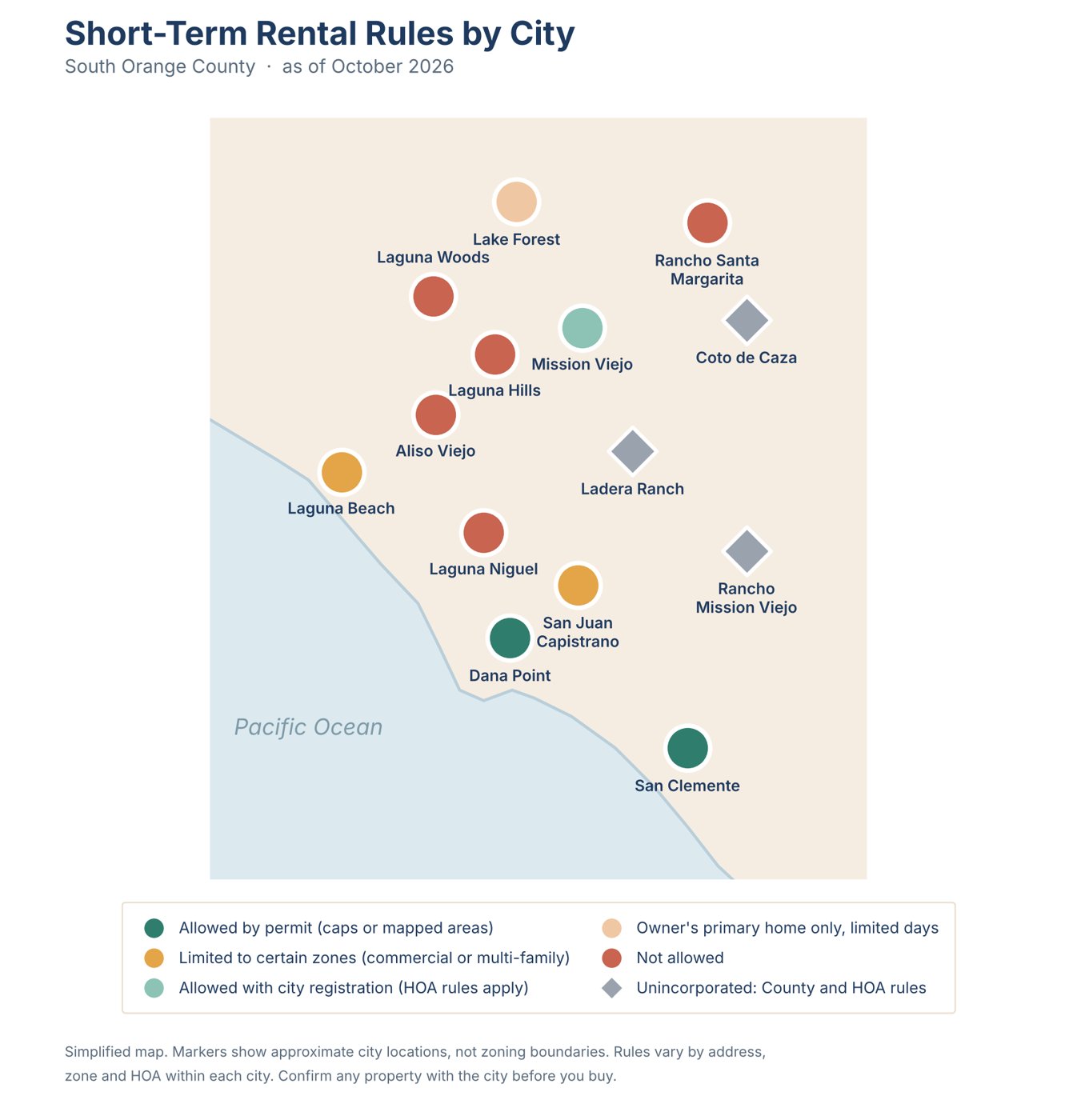
A short-term rental (STR) is a furnished stay of 30 days or less. In South Orange County, several cities ban them entirely. Before you buy, confirm three things: the city allows STRs at that address, a permit is actually available, and the HOA allows them.
| City | Status | What to know |
|---|---|---|
| Dana Point | Allowed by permit, with caps | Up to 115 permits in the coastal zone and 115 outside it (no more than 60 non-owner-occupied outside it). Owner-occupied and home-stay rentals get priority, and a waitlist applies once caps fill. HOA approval is required in the coastal zone. |
| San Clemente | Allowed in designated areas | Permitted in mapped Short-Term Lodging Unit (STLU) areas, mainly near the beach, downtown and the Pier Bowl. Most low-density single-family neighborhoods are excluded, and each area is capped at 20% of its homes. Requires a one-time zoning permit, an annual operating license and bed tax registration. |
| Laguna Beach | Commercial and mixed-use areas only | New STRs are banned in residential zones. Permits are capped at 300 citywide, plus up to 165 home-share permits where the host stays on site. Permits last three years and don’t transfer with a sale. |
| San Juan Capistrano | Multi-family zones only | Not allowed in single-family zones. Allowed in multi-family (RM) and very high density zones with a business license and bed tax registration. |
| Mission Viejo | Allowed with city registration | Requires registration and bed tax collection. Many HOAs prohibit STRs, so check the CC&Rs first. |
| Lake Forest | Owner’s primary home only | Investment STRs aren’t allowed. Owners may rent their own primary home up to three times a year (90 days total), with registration and bed tax. |
| Laguna Niguel, Aliso Viejo, Laguna Hills, Laguna Woods, Rancho Santa Margarita | Not allowed | Rentals under 30 days are prohibited. |
| Unincorporated areas (Ladera Ranch, Rancho Mission Viejo, Coto de Caza, Las Flores) | County and HOA rules | County of Orange rules apply. These master-planned communities have strict HOA rules, so check the CC&Rs before anything else. |
Running an STR also means
- Collecting and paying transient occupancy tax (bed tax), typically around 8% to 10% depending on the city
- Following occupancy, parking, noise and trash rules, with fines for violations
- Carrying short-term rental insurance, which standard homeowners policies usually don’t cover
- Notifying neighbors in some cities and posting a local 24/7 contact
Check a specific address
Eligibility comes down to the exact property. Use the official city resources:
- San Clemente: Map of STLU Allowed Areas (sanclemente.gov)
- Dana Point: interactive map of permitted STRs and the current permit list (danapoint.org)
- Laguna Beach and San Juan Capistrano: confirm zoning with the city’s planning department
Rules change often, especially in coastal cities. Always confirm a specific address with the city’s planning department before you make an offer.
Thinking about the short-term rental route?
A well-run STR takes pricing, guest communication, cleaning, maintenance, reviews and tax filings, often seven days a week. I work with a trusted South Orange County short-term rental manager, and I’m happy to introduce you so you can get a rental income estimate on a specific property.
The simplest way to build income and equity
A long-term rental is a lease of 30 days or more, usually 12 months. It’s allowed everywhere in South Orange County, subject to HOA rules.
California rules to know
- Statewide rent cap: under the Tenant Protection Act (AB 1482), increases on covered units are limited to 5% plus local inflation, never more than 10% a year
- Common exemptions: single-family homes and condos owned by individuals can be exempt, but only with the required exemption notice in the lease. Homes built within the last 15 years are also exempt.
- Just cause: after a tenant has lived in a covered unit for a year, you generally need a legal reason to end the tenancy. Some no-fault reasons require relocation assistance of one month’s rent.
- Deposits and fair housing: most security deposits are limited to one month’s rent, with strict screening rules
Run the numbers on
- Realistic market rent (ask me for recent rental comps)
- Mortgage, property taxes, insurance and HOA dues
- A vacancy allowance and a repair and maintenance budget
- Property management, typically a percentage of monthly rent
- Your HOA’s leasing rules, such as minimum lease terms or rental caps
Accessory dwelling units
An ADU is a second, smaller home on the same lot: a detached backyard cottage, an addition, or a converted garage. A JADU (junior ADU) is a smaller unit of up to 500 square feet carved out of the main house. California law makes ADUs easier to build than almost any other kind of addition.
What state law generally allows
- At least one ADU, and often a JADU too, on most single-family lots
- Detached ADUs up to 1,200 square feet, with reduced side and rear setbacks
- A decision on a complete permit application within 60 days
- No impact fees on ADUs under 750 square feet (school and utility fees can still apply)
- No owner-occupancy requirement for ADUs; JADUs still require the owner to live on site
Before you buy with ADU plans
- Confirm the lot’s size, slope, access and utilities can support a unit
- Check HOA rules and the city’s ADU standards, especially in the coastal zone
- Get a realistic build estimate and timeline from a local ADU builder
- Compare the expected rent to your build cost and financing
Investor mistakes to avoid
- Assuming a seller’s STR permit comes with the house. In most cities it doesn’t.
- Skipping the HOA documents. Many South County HOAs ban STRs or set minimum lease terms, even where the city allows them.
- Using vacation-season income for the whole year. Base your numbers on a full year, including slow months.
- Forgetting bed tax, insurance and management fees. They can take a big share of STR revenue.
- Buying a home with an unpermitted ADU. It can limit financing, insurance and legal rent.
- Missing the exemption notice in a lease. Without it, a single-family rental can fall under the state rent cap.
- Waiting to talk to a lender. Investment loans have different down payment, rate and reserve requirements.
Ready to find the right investment property?
Let’s talk about your goals, budget and timeline, and which strategy fits you best. No pressure, no obligation.
This guide is for general educational purposes only and is not financial, legal or tax advice. Short-term rental, ADU and rental housing rules change often and vary by address, zone and HOA. Information is believed accurate as of October 2026 but is not guaranteed. Confirm current rules with the city or county, and consult a qualified attorney, tax professional or lender before you buy.
